
Description
Product Overview
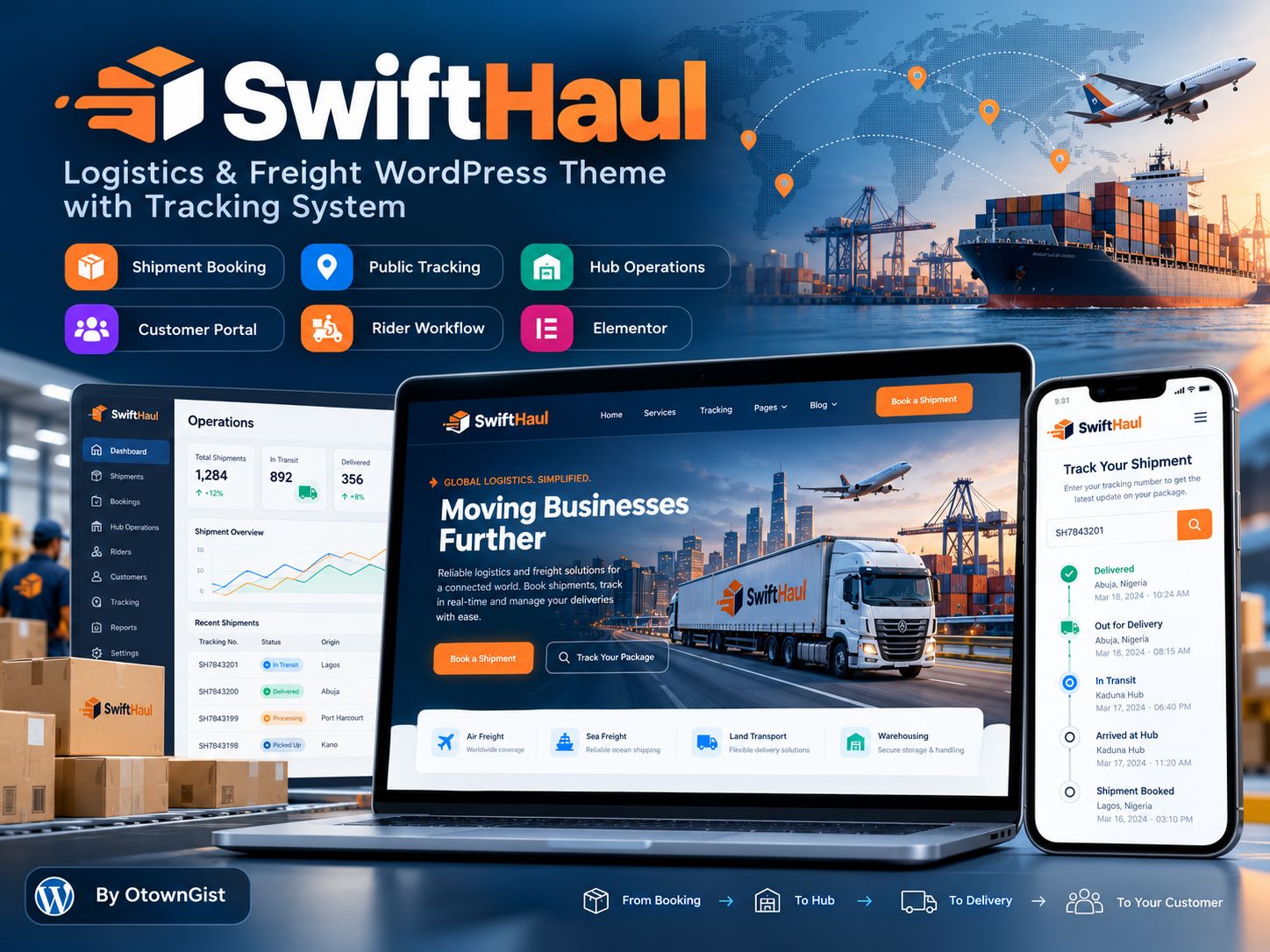
SwiftHaul is more than a logistics website template. It is a modular WordPress logistics platform designed to combine the public-facing website of a courier or freight company with practical shipment and delivery workflows.
The system supports courier, freight, warehousing, hub, pickup and final-mile delivery operations.
SwiftHaul separates presentation from operational logic. Elementor controls the customer-facing design while shipment, tracking, operations and delivery rules remain inside dedicated SwiftHaul plugins. This means buyers can redesign their website without turning critical logistics data into ordinary page-builder content.
Who It Is For
SwiftHaul is suitable for:
Courier companies
Logistics businesses
Freight companies
Haulage operators
Delivery businesses
Dispatch services
Warehousing businesses
Pickup and final-mile delivery companies
Transport companies
Corporate logistics providers
What Makes SwiftHaul Useful
A normal logistics WordPress theme usually stops at service pages and a contact form.
SwiftHaul goes further by connecting the marketing website to actual operational workflows.
Customers can discover services, request pricing, create bookings, track shipments, view delivery progress, complete receiver confirmation and submit support requests.
Operations teams can work with shipments, packages, hubs, manifests, scans, riders, delivery attempts, custody information and proof of delivery.
Public Logistics Website
SwiftHaul supports dedicated content for courier services, air freight, sea freight, road freight, warehousing, customs and clearance, and corporate logistics.
The public website can include coverage information, statistics, process sections, testimonials, FAQs, service information and customer calls to action.
Shipment & Package Management
Administrators can create shipments containing sender and receiver details, route information, package details, weight, dimensions, declared value, service options, pickup information and delivery details.
The platform can generate tracking numbers and package-level identifiers for multi-piece shipments.
Shipment records can maintain tracking events, expected actions, custody history, audit history, delivery attempts and proof-of-delivery information.
Public Shipment Tracking
Customers can search for shipments using a tracking number.
Tracking information can include current shipment status, recorded events, expected next actions, origin, destination, estimated arrival information where recorded, package/service details and the last recorded location.
When a shipment reaches the Out for Delivery stage, the system can display relevant delivery officer or delivery partner information.
Completed shipments can display proof-of-delivery information.
Receiver OTP Confirmation
SwiftHaul provides per-shipment receiver confirmation rules.
Where OTP confirmation is enabled, the system supports a six-digit code workflow with expiration, resend cooldown and incorrect-attempt protection.
Successful confirmation can complete the shipment and create the appropriate tracking, audit and proof-of-delivery records.
Hub Operations
SwiftHaul provides operational workflows for hubs and package movement.
Staff can work with assigned hub context, package counts, incoming and outgoing manifests, recent package activity and permitted scan operations.
Operational scanning is designed to synchronize package state, shipment status, tracking history, custody information and audit history.
Rider & Final-Mile Operations
Delivery officers and riders use assigned delivery jobs rather than unrestricted shipment access.
Riders can receive the recipient information necessary to complete assigned deliveries, record failed delivery attempts, submit proof of delivery and follow OTP confirmation requirements where configured.
The system is designed to keep normal rider operations on the frontend instead of requiring routine access to the WordPress administration dashboard.
Shared Staff Portal
SwiftHaul provides a shared staff entry point at:
/hub/
After authentication, the platform detects the staff role and loads the appropriate workspace.
Supported documented roles include Operations Manager, Hub Manager, Hub Staff and Delivery Officer/Rider.
Shipment Lifecycle
The documented operational lifecycle includes:
Created / Booked
Pickup Scheduled
Picked Up
At Origin Hub
In Transit
At Destination Hub
Out for Delivery
Delivered
Hold / Exception
This gives businesses a structured model for movement from booking through final delivery.
Pricing, Quotes & Booking
SwiftHaul includes a courier pricing and booking foundation.
Pricing inputs can include origin and destination zones or locations, package type, quantity, actual weight, dimensions, volumetric and chargeable weight concepts, service level, pickup method and declared value or insurance foundations.
Complex freight services can remain quote-based rather than forcing an unrealistic instant price.
Booking is designed to create operational shipment, payment and package records rather than behaving like a simple contact form.
Customer Portal
SwiftHaul includes an authenticated customer dashboard foundation.
Customers can access shipment information linked to their account while remaining separate from staff operations.
Support & Exception Handling
Customers can access workflows such as:
Reschedule Delivery
Report Shipment Issue
Contact Support
Support requests can be stored with references for operational follow-up.
The logistics workflow also supports hold, exception and failed-delivery states.
Email & SMTP
SwiftHaul provides email configuration including provider selection, From Name, From Email, Reply-To details, administrative notifications, support email and SMTP credentials.
A test-email function is documented.
Actual production delivery still depends on the email provider and proper domain authentication.
SMS
The integration layer provides configurable SMS provider settings including API or webhook URL, API credentials, Sender ID, country code and delivery-report configuration.
A test-SMS action and generic adapter/webhook foundation are included.
Provider-specific production configuration is still required.
SwiftHaul includes configurable WhatsApp integration settings for provider/API URL, token, Phone Number ID, Business Account ID, default number, webhook secret and template namespace.
Actual provider templates and production rules depend on the connected WhatsApp service.
Payments
The product provides a payment integration foundation with provider configuration, public and secret keys, test/live mode, currency, checkout adapter URL, webhook secret, success/failure settings and authenticated payment-status callback foundations.
A real payment gateway or adapter must still be configured and tested.
Maps
SwiftHaul supports maps configuration including provider/API key, geocoding and route settings, default country or map centre and distance units.
Recorded location information is supported.
SwiftHaul should not be marketed as providing live GPS tracking unless a genuine live-location provider is connected.
Webhooks
General webhooks can be enabled for selected shipment, payment and support events.
The configuration includes endpoint and signing-secret support.
Elementor Editing
Major public demo pages are designed to remain Elementor-editable.
SwiftHaul includes custom Elementor components for logistics-specific interfaces and content.
Documented widgets include Hero, Tracking, Calculator, Support Form, Service Grid, Stats, Process, FAQ, Testimonials, CTA, Media, Feature and Locations.
The Hero system supports desktop/mobile image or video backgrounds, slides, calls to action, content width controls, horizontal and vertical positioning, alignment and padding.
This gives site owners control over presentation while keeping logistics data and business logic inside the SwiftHaul application layer.
Administration
SwiftHaul administration includes shipment creation and editing, sender and receiver information, package data, delivery details, audit history, hubs, staff accounts, support requests, payment records, notification logs, Scan & Labels, Production Readiness checks, integration configuration and setup/demo-page installation.