
From First News Video to Leadership: How OtownGist Is Building Young Media Talent in Owerri
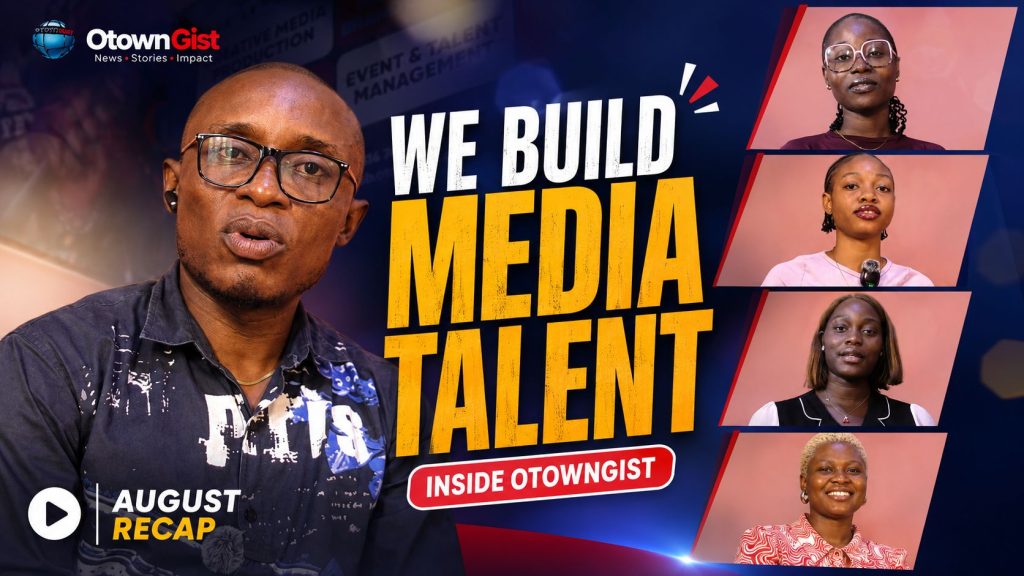
For five young people at OtownGist Media & Creative Hub, August 2026 came with a milestone they are unlikely to forget quickly.
They presented their first news videos.
Seven new interns joined OtownGist during the month. Before August ended, five had already moved from learning and observing to standing in front of the camera and producing work that was published for a real audience.
For some, that first experience came with considerable nervousness.
Then the videos went online.
Friends watched. Family members reacted. People shared the content and left comments. What had initially looked intimidating became evidence that they could actually do it.
That transition — from uncertainty to published work — captures an important part of the philosophy behind media internship and training at OtownGist.
People learn by doing.
Moving Beyond the Traditional Internship
A media internship can easily become months of observation.
The intern comes in, watches experienced people work, runs occasional errands and eventually leaves with a completed logbook but little evidence of what he or she can independently produce.
OtownGist is deliberately trying to build something different.
Interns are introduced to the actual process of media production and gradually expected to participate in it.
That can mean researching stories, writing, presenting news, supporting productions, working in the studio, creating digital content, participating in editorial discussions or learning how published content is distributed to an audience.
The objective is not to create instant experts.
It is to ensure that experience replaces some of the uncertainty young people naturally have when they encounter professional media work for the first time.
The First Video Changes Something
For an aspiring broadcaster, there is a significant difference between practising privately and knowing that your presentation is about to be published.
Covenant, one of the interns featured in OtownGist’s August recap video, described being tense when she first entered the studio to present news.
It was the first time she was producing something that virtually anyone could watch.
After the video was published, the response from friends and family changed the experience.
Thelma had a similar reaction.
Seeing people share her work, comment on it and send messages gave her a sense of excitement and confidence.
For a young person entering media, moments like these matter.
The equipment is important.
The lessons are important.
But eventually someone has to press record.
Eventually the work has to leave the studio.
Eventually an aspiring presenter has to become a presenter.
That is where practical experience begins.
Interns Should Produce Evidence of Growth
One question should be asked at the end of any serious internship:
What can this person now do that they could not confidently do before?
A certificate alone cannot answer that question.
A portfolio can.
A published news presentation can.
A written article can.
A completed interview can.
A video production can.
A responsibility successfully handled can.
For young people trying to build careers in journalism, broadcasting and digital media, this evidence becomes particularly important because employers and collaborators increasingly want to see what a person can actually produce.
That is why OtownGist places emphasis on giving interns opportunities to create rather than limiting their experience to observation.
Why Leadership Has Become Part of the Training
August also marked another change within the OtownGist team.
Some existing team members were assigned responsibilities they had never handled before.
The goal is to develop more than employees or content producers.
It is to develop people capable of leading others.
Favour, a presenter who also helps coordinate interns, spoke about the challenge of giving instructions and managing a group of adults with different personalities.
It has not always been easy.
That is precisely why the experience matters.
Leadership cannot be learnt entirely from a presentation or textbook.
Someone eventually has to coordinate the team when things become difficult.
Someone has to communicate instructions.
Someone has to solve a problem.
Someone has to take responsibility.
Chidinma, a senior intern, faced a similar experience after being assigned unfamiliar tasks. Her initial reaction was to wonder whether she could handle them.
Rather than retreating, she researched, worked through the responsibilities and began growing into the role.
Solomon has also taken greater responsibility for coordinating creative work and helping to keep colleagues organised.
These are deliberate experiments in leadership.
An Editorial Meeting That Builds People
OtownGist’s editorial meeting is also being repositioned.
It still exists to discuss stories, productions and the work ahead.
But its purpose is becoming broader.
The meeting is increasingly being used as a place to develop judgement, responsibility, communication and leadership among younger members of the team.
Founder Chinedu Hardy Nwadike describes his approach to assigning difficult responsibilities simply: people are often more capable than they initially believe.
Fear can easily be mistaken for inability.
The only reliable way to discover the difference is to attempt the work.
That means people will occasionally struggle.
They will make mistakes.
Their first presentation will not look like their fiftieth.
Their first attempt at managing colleagues may be uncomfortable.
But eliminating every uncomfortable experience would also eliminate much of the growth.
Building a Support System Around Young Creatives
Practical training does not mean throwing beginners into difficult situations without support.
OtownGist combines responsibility with access to people who can guide interns through the process.
The hub provides a working media environment where learners can interact with presenters, writers, production personnel and other members of the team.
Interns also have access to studio and production facilities.
Presenters can receive wardrobe support where necessary, reducing another barrier that can prevent young people from feeling prepared for their first appearances on camera.
The larger objective is to create an environment where a beginner has enough support to attempt something difficult without being protected from the experience of actually doing it.
The Evidence Is Becoming More Important Than the Promise
OtownGist has worked with interns, trainees and journalism students at different stages of development.
Earlier in 2026, 77 Journalism and Media Studies students from Imo State University participated in a practical training programme involving digital storytelling, broadcast writing, interviews, studio presentation and production activities.
The new August interns represent another stage in the same direction: creating a continuous pathway through which young people can gain practical media experience in Owerri.
That track record matters.
Anyone can advertise a media training programme.
The more important question is what participants actually produce.
Over time, OtownGist wants the answer to be visible in the work of the people who pass through its doors.
More Than Learning How to Use a Camera
Modern media requires far more than technical ability.
Young professionals need to research.
They need to communicate.
They need editorial judgement.
They need confidence.
They need to work with other people.
They need to understand audiences.
They need to take responsibility for deadlines and mistakes.
And increasingly, they need the ability to lead.
That is why OtownGist’s internship model is gradually expanding from skills development into professional and leadership development.
The goal is not simply to teach someone how media equipment works.
The goal is to help that person become more useful, confident and capable.
A Simple Standard for Every OtownGist Intern
There is one standard that can summarize the entire approach:
Do not leave the same person who walked in.
If an intern arrived afraid of the camera, there should be evidence of greater confidence.
If they could not write a publishable story, there should be progress.
If they had never participated in a production, they should understand the process better.
If they had never been responsible for other people, there should be opportunities to develop leadership.
Growth does not happen at the same speed for everyone.
But there should be growth.
August provided another glimpse of that process.
Seven young people joined the team.
Five have already published their first news presentations.
Others within the organisation are carrying responsibilities they had never handled before.
And a new month has started with a higher expectation:
Build the organisation, but build the people at the same time.
For students and young people looking for a practical media internship, journalism training or industrial training opportunity in Owerri, Imo State, that is the experience OtownGist Media & Creative Hub is working to provide.
Learn. Create. Produce. Lead.