
How to Get Your Business Found When People Ask AI
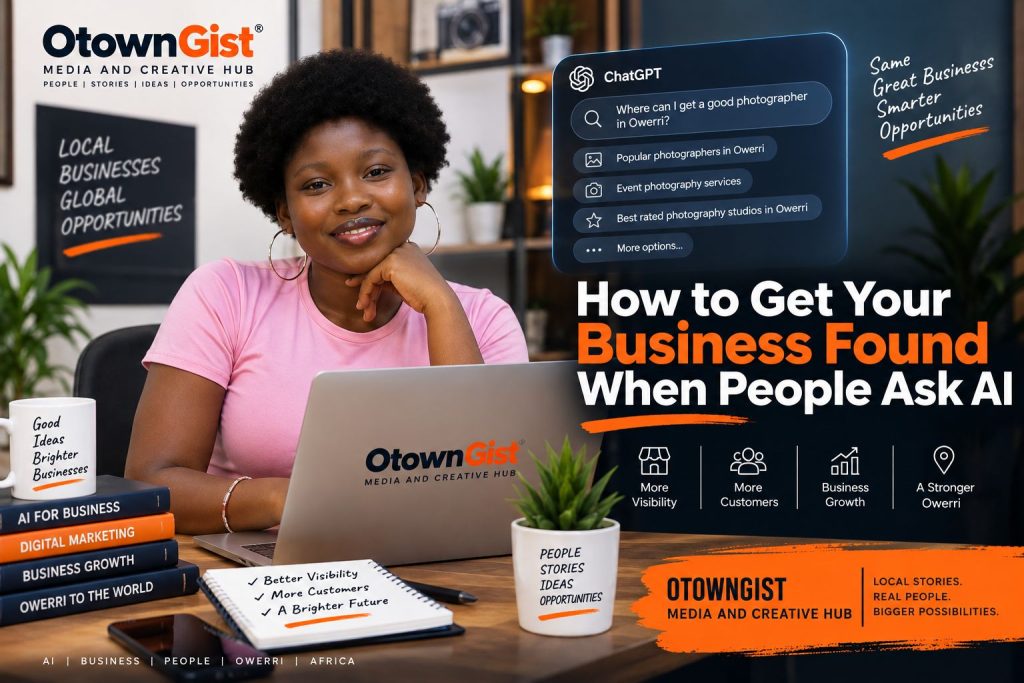
Imagine you run a business in Owerri or any part of the world.
You have good products. Your customers are happy. You post on WhatsApp Status, Instagram and Facebook. Some customers even recommend you to their friends.
But here’s a question many business owners haven’t started asking yet:
What happens when a potential customer asks AI to recommend a business like yours?
Someone could ask:
“Where can I find a good photographer in Owerri?”
Or:
“Who does website design in Imo State?”
“Where can I buy quality cakes in Owerri?”
“Which training centre offers digital skills in Owerri?”
“Can you recommend an event planner near me?”
The AI gives an answer.
Is your business part of that answer?
This is becoming an important question as people use AI tools not only to write, brainstorm and learn, but also to research products, compare options and discover businesses.
OpenAI’s current shopping features, for example, allow users to describe what they want and receive product options that can be compared using information such as price, features and reviews. Product and merchant information can come from public retail sources and merchant data.
For a business owner, this doesn’t mean you should panic and start chasing every new AI trend.
It means you should start paying attention to how your business is represented online.
What is AI visibility?
The term may sound technical, but the idea is simple.
AI visibility is how easily AI-powered tools can find, understand and accurately describe information about your business.
There is no magic button that says, “Put my business on ChatGPT.”
And anyone promising that they can guarantee your business will appear in every AI recommendation is promising more than they can control.
AI systems use different sources and processes, and results can change depending on the question, the platform and the information available.
What you can control is the information you put into the digital world.
If your website, social profiles, business listings and other public information clearly explain who you are, what you do, where you operate and how customers can reach you, you’re giving people and search systems a much better chance of understanding your business.
Your customers are changing how they search
For years, a typical search might have looked like this:
“photographer Owerri”
Now a customer can ask a much more detailed question:
“I need a photographer for my birthday celebration in Owerri. Who would you recommend?”
That difference matters.
The customer isn’t simply looking for a keyword.
They’re describing a need.
AI tools are designed to understand conversational questions, so businesses need to think beyond just having their business name somewhere online.
Think about the questions your customers ask you every day.
A fashion designer may constantly hear:
“How much do you charge for this style?”
“Do you make clothes for children?”
“How long does it take?”
“Where is your shop?”
A photographer may hear:
“Do you cover weddings?”
“How much is a birthday shoot?”
“Do you travel outside Owerri?”
A training centre may hear:
“Do you teach beginners?”
“How long is the training?”
“Do I need a laptop?”
Those questions are valuable.
They tell you exactly what information your online presence should contain.
Start with an AI visibility test
You don’t need expensive software to get started.
You can do your first test with your phone.
Open an AI tool and ask a question that your potential customer might genuinely ask.
For example:
For a restaurant:
“What are some good restaurants in Owerri?”
For a photographer:
“Who provides professional photography services in Owerri?”
For a fashion designer:
“Can you recommend a fashion designer in Owerri?”
For a training centre:
“Where can I learn digital skills in Owerri?”
Then look at the results.
Is your business mentioned?
If it isn’t, don’t immediately conclude that your business has poor visibility.
AI answers can vary, and one result doesn’t tell the whole story.
Instead, use the exercise to ask a more useful question:
“What information about my business is available online, and is it clear enough?”
That is where your real work begins.
Make your business easy to understand
Here’s one mistake many businesses make online.
They try so hard to sound professional that they forget to explain what they actually do.
A website might say:
“We create exceptional experiences through innovative solutions.”
It sounds polished.
But what does the company actually provide?
Compare that with:
“We provide event photography, videography and livestreaming services in Owerri, Imo State.”
Now it’s clear.
You know the service.
You know the location.
And you know whether the business is relevant to you.
Your website and public business profiles should clearly answer questions such as:
- What is your business called?
- What products or services do you offer?
- Where are you located?
- Which areas do you serve?
- How can customers contact you?
- What are your opening hours?
- What does your service cost, where appropriate?
- What makes your business different?
- Can customers see examples of your work?
- What do previous customers say about you?
Don’t make a customer search through 50 Instagram posts to find your phone number.
Don’t make someone send you a WhatsApp message just to discover where your shop is.
And don’t expect an AI tool to accurately understand information you haven’t clearly published.
Your website still matters
There has been plenty of discussion about AI changing search.
But don’t make the mistake of thinking your website no longer matters.
Your website remains one of the most useful places to explain your business properly.
If you’re a photographer in Owerri, for example, your website shouldn’t only say:
“Welcome to our creative world.”
Tell people what you actually do.
You could have useful pages such as:
- Wedding Photography in Owerri
- Birthday and Event Photography
- Corporate Photography
- Photography Packages
- Frequently Asked Questions
If you provide website design, you might have:
- Website Design in Owerri
- Business Website Packages
- E-commerce Website Design
- Website Maintenance
- Frequently Asked Questions
The point isn’t to repeat “website design in Owerri” fifty times.
That’s not good SEO.
The point is to create useful information that answers the questions your customers are already asking.
Google continues to emphasise useful, people-first content and sound SEO foundations as search evolves to include AI-powered experiences.
Don’t ignore Google Business Profile and other public profiles
Your website isn’t the only place customers learn about you.
Think about all the places your business appears online:
- Google Business Profile
- WhatsApp Business
- Business directories
- Industry websites
- Review platforms
- Your own website
Make sure the basic information is consistent.
If your Facebook page says one location, your website says another and your Google profile has an old phone number, you’re creating unnecessary confusion.
A customer shouldn’t have to wonder:
“Which one is correct?”
Keep your business name, location, phone number, website and core services as consistent and accurate as possible.
Reviews can help tell your story
Think about how you choose a business.
If someone recommends a restaurant, photographer, mechanic or training centre to you, you might immediately ask:
“Have you used them before?”
“Were they good?”
“How much did they charge?”
“Would you recommend them?”
That’s why your online reputation matters.
Encourage genuine customers to leave honest reviews on appropriate platforms.
Publish real examples of your work.
Show completed projects.
Answer customer questions.
Keep your information updated.
And don’t manufacture fake reviews.
A strong digital presence isn’t built by pretending your business is better than it is.
It’s built by making the real value of your business easier to see.
Don’t turn your website into an AI content dump
Here’s another trap business owners should avoid.
You discover ChatGPT and think:
“Let me generate 200 articles this weekend so Google and AI will notice my business.”
Slow down.
More content doesn’t automatically mean more visibility.
If you publish dozens of generic articles that don’t help your customers, you’ve simply added more noise to the internet.
AI can help you research topics, brainstorm ideas, structure articles, create drafts and work faster.
But your experience still matters.
Your knowledge of your customers matters.
Your understanding of your market matters.
Your actual products and services matter.
Use AI to improve your work, not to replace the thinking behind your business.
Google has also warned against using generative AI to produce large amounts of content without adding real value for users.
What AI needs to know about your business
Here’s a simple way to think about your online presence.
Imagine that tomorrow you hand your business to a new employee and tell them:
“Go online and explain our business to a customer.”
Would they have enough information to do it correctly?
They would need to know:
Business name: What are we called?
Location: Where are we?
Services: What exactly do we provide?
Customers: Who do we serve?
Coverage: Which locations do we serve?
Contact: How can customers reach us?
Experience: What work have we done?
Trust: What do our customers say?
Questions: What do customers frequently want to know?
That same thinking can help you improve your digital presence.
Don’t just publish information.
Organise the information around the questions people actually ask.
A simple 10-minute AI visibility exercise
Let’s make this practical.
Step 1: Think like your customer
Write down three questions someone might ask when looking for your service.
For example:
“Who does professional graphic design in Owerri?”
“Where can I get affordable website design in Imo State?”
“Who provides event videography in Owerri?”
Step 2: Ask an AI tool
Enter those questions into an AI search or answer tool.
Step 3: Look at the results
Which businesses appear?
What information does the AI provide about them?
Are the details accurate?
Step 4: Search for your own business
Ask:
“What do you know about [Business Name]?”
Now check the response carefully.
Is your location correct?
Are your services correct?
Does the AI understand what you do?
Is important information missing?
Is anything completely wrong?
Step 5: Fix what you can
Review your website and public business profiles.
Update old phone numbers.
Correct your location.
Explain your services more clearly.
Add useful FAQs.
Publish real examples of your work.
Make your business information consistent.
Then test again later.
This is not about trying to trick an AI system.
It’s about making your business clearer, more accurate and easier to understand.
What about businesses that don’t have a website?
This is important, especially for smaller businesses.
You may be thinking:
“I don’t even have a website. How am I supposed to do all this?”
Don’t let that stop you.
Start with the digital platforms you already use.
Make sure your business information is complete and accurate on the platforms where customers can find you.
Your Facebook page, Instagram profile, Google Business Profile, WhatsApp Business information and other legitimate online listings can all contribute to your overall digital presence.
But if your business is growing, a website is still worth considering.
Think of it as your home on the internet — a place where you control how your business, services and expertise are presented.
This isn’t only for big companies
You might be thinking:
“But I’m just a small business in Owerri.”
That’s exactly why this matters.
You don’t need to be a multinational company before your digital presence becomes important.
You could be running:
A fashion business.
A restaurant.
A hotel.
A photography studio.
A salon.
A real estate business.
A school.
A training centre.
A printing business.
A catering service.
A repair business.
A consulting practice.
A small retail shop.
Or a creative business operating from one office in Owerri.
If people can search for what you offer, your business needs to be understandable online.
And as AI becomes another way people discover information, products and services, this is a conversation worth starting now.
AI search is also becoming important for products
For businesses that sell physical products, the change is even more interesting.
AI shopping tools are increasingly allowing people to describe what they want, compare products and consider factors such as price, features and reviews.
OpenAI’s current shopping experience, for example, can use public product information and merchant-provided data to help users discover and compare products.
That means product businesses should pay attention to the information they publish about what they sell.
Don’t simply write:
“Quality shoes available.”
Be specific.
What type of shoes?
Which sizes?
What materials?
What colours?
What price range?
Where are they available?
How can customers order?
What makes them different?
Clear product information helps customers make decisions — and gives digital systems better information to work with.
How OtownGist can help
This is one of the reasons we’re making practical AI education a bigger part of what we do at OtownGist Media and Creative Hub.
We don’t believe AI training should be about showing people a few fancy prompts and sending them home.
The more important question is:
“What can you actually do with AI to improve your work or business?”
OtownGist can help individuals, businesses and organisations understand practical applications of AI in areas such as:
- Content creation
- Research
- Communication
- Marketing
- Productivity
- Digital visibility
- Business workflows
- Information management
For a business owner, that could mean looking at your current digital presence, identifying information gaps, improving the way your business presents itself online and learning practical ways to use AI in your daily operations.
For an organisation, it could mean training your team to use AI more effectively instead of having everyone experiment randomly with different tools.
For young people and individuals, it means developing practical AI skills that can be useful in school, work, freelancing, content creation and business.
And for businesses in Owerri, Imo State and across Nigeria, it means bringing AI education closer to the realities of the people actually using it.
Because AI shouldn’t only be something we hear about.
We should know how to use it.
Start with one question
You don’t have to become an AI expert today.
Start with this:
“If someone asked an AI tool to recommend a business that provides what I offer, would there be enough accurate information online for it to understand my business?”
If you don’t know the answer, run the 10-minute test.
You may discover that your business has a visibility problem.
You may discover that your information is outdated.
You may discover that customers can’t easily find your services.
Or you may discover that you’re already doing some things right.
Whatever you find, now you have something you can work on.
Because the future of digital business isn’t simply about being online.
It’s about being understandable, discoverable and useful when people are looking for what you offer.
And increasingly, some of those people will be asking AI.
This is the first AI Tip from OtownGist.
We’ll keep bringing you practical AI tips you can actually use — one real problem, one useful solution at a time.